
What Is RTP in Gambling?

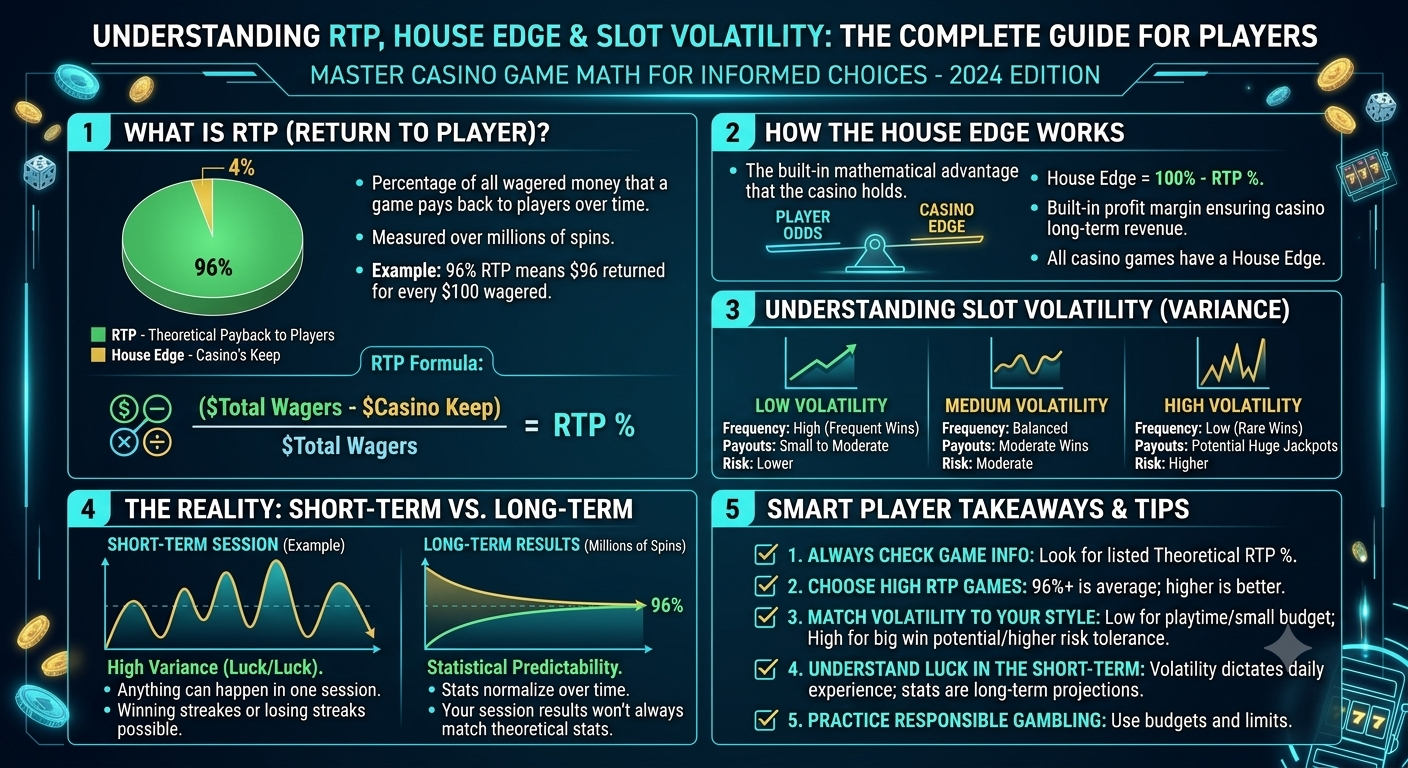
RTP, or Return to Player, is one of the most commonly discussed terms in online casino games, especially slots. It represents the theoretical percentage of total wagers that a game is designed to return to players over a very large number of rounds.
Understanding RTP can help readers learn how casino games are mathematically structured. However, it is important to remember that RTP does not predict the result of an individual spin or guarantee that a player will receive a particular amount.
For example, a slot with a theoretical RTP of 96% is designed to return an average of $96 for every $100 wagered across a sufficiently large number of game rounds. The remaining $4 represents the theoretical house edge.
In this guide, we explain how RTP works, how it relates to House Edge, who determines it, how to check a game’s RTP, and why volatility and variance also matter.
What Does RTP Mean in Gambling?
RTP stands for Return to Player. It is expressed as a percentage and represents the theoretical proportion of all wagers that a game returns as winnings over time.
For example:
- A game with 96% RTP has a theoretical return of $96 for every $100 wagered.
- A game with 94% RTP has a theoretical return of $94 for every $100 wagered.
- A game with 90% RTP has a theoretical return of $90 for every $100 wagered.
These examples describe long-term mathematical expectations, not guaranteed personal returns.
Important Things to Understand About RTP
1. RTP is a theoretical figure
RTP is calculated using a game’s mathematical model and a very large number of rounds. Actual results over a short period can be significantly different.
2. RTP does not guarantee individual winnings
A player might receive a large payout in a short session, while another might receive very little. Both outcomes can occur in a game with the same theoretical RTP.
3. RTP is not a prediction tool
A higher RTP does not tell you when a game will pay out. It only describes the theoretical return built into the game’s mathematics.
4. Different versions may have different RTP values
Some game providers release multiple RTP configurations for the same title. Therefore, the percentage shown in a general review may not match the version available in a particular game environment.
RTP vs House Edge: What Is the Difference?
RTP and House Edge describe two sides of the same mathematical concept.
- RTP: The theoretical percentage returned to players.
- House Edge: The theoretical percentage retained by the casino over time.
The basic relationship is:
House Edge = 100% − RTP
For example, if a game has an RTP of 96%, its theoretical House Edge is 4%.
RTP and House Edge Examples
| Game | Example RTP | Example House Edge |
|---|---|---|
| Slot game | 96% | 4% |
| European Roulette | 97.30% | 2.70% |
| American Roulette | 94.74% | 5.26% |
| Blackjack* | 99.50% | 0.50% |
| Baccarat – Banker bet | 98.94% | 1.06% |
These are illustrative figures. Actual returns depend on the game’s rules, configuration and, for some table games, the decisions made during play.
How Do RTP and House Edge Work Over Time?
Imagine a game with a theoretical RTP of 96%. Across a sufficiently large number of wagers, its overall return may approach that percentage.
However, the results of a small number of rounds can vary widely. A player may experience several losses in a row or receive an unusually large payout.
This is why RTP should be understood as a long-term statistical measure rather than a forecast of what will happen in a particular session.
Who Determines the RTP of a Casino Game?
RTP is generally established during the mathematical design and development of a game. Several parties may be involved in creating, testing and overseeing the game.
1. Game Developers and Providers
Game developers design the mathematical model that determines factors such as:
- Possible winning combinations
- Payout values
- Probability of different outcomes
- Bonus feature probabilities
- Theoretical return percentage
Providers may publish RTP information in a game’s specifications or help section.
Examples of well-known game development studios include Pragmatic Play, NetEnt, BGaming and Microgaming. The availability and configuration of individual games can vary by market and operator.
2. Independent Testing Laboratories
Independent testing laboratories may examine game software, random number generators and mathematical calculations.
Examples include:
- eCOGRA: Provides testing, inspection and certification services for parts of the online gaming industry.
- Gaming Laboratories International (GLI): Tests gaming systems and software.
- iTech Labs: Provides testing and certification services for gaming products.
- BMM Testlabs: Offers testing and compliance services for gaming technology.
Testing and certification requirements depend on the relevant market and regulatory framework. A certification should always be checked against the issuing organisation and the specific product or operator.
3. Regulatory Authorities
Regulatory authorities establish requirements for gaming operators and software providers within their jurisdictions.
Examples include the UK Gambling Commission and the Malta Gaming Authority. Different jurisdictions have different licensing, testing and disclosure requirements.
A regulator’s name or a licence claim should not be accepted without checking the official register and confirming that the licence applies to the specific operator and service.
Can an Online Casino Change the RTP?
This question often comes up when people compare the same slot game across different websites.
A game operator generally does not directly rewrite a provider’s mathematical model. However, some providers make multiple approved RTP configurations available for a particular game.
An operator may offer a version with a different RTP where the provider and applicable regulatory framework permit it.
Why Can the Same Slot Have Different RTP Values?
Consider a hypothetical slot with these available configurations:
| Version | Example RTP |
|---|---|
| Version A | 96.50% |
| Version B | 95.50% |
| Version C | 94.50% |
| Version D | 88.00% |
These are illustrative values, not a claim about a specific game.
The same title may therefore display different RTP percentages in different environments. This is one reason why checking the actual game information is more useful than relying only on an old review or a general provider description.
Does a Lower RTP Mean the Game Is Manipulated?
Not necessarily. A different RTP configuration can be part of a provider’s approved game design.
However, players and researchers should not assume that every configuration is properly authorised. The relevant provider documentation, testing information and regulatory requirements should be checked where available.
How to Find the RTP of a Specific Slot
If you want to understand the mathematical information associated with a slot, there are several places to check.
1. Check the Game’s Information Menu
Many games provide an information or help section. Look for:
- Game rules
- Paytable
- RTP percentage
- Bonus feature explanations
- Game specifications
The information may appear behind an icon marked with an “i” or a question mark.
2. Visit the Game Provider’s Website
The official provider website may publish game specifications, including RTP.
However, a provider’s website may list more than one configuration. The maximum advertised RTP may not be the version used in a particular environment.
3. Review Available Game Information
Some operators publish game information or RTP lists. Check whether the figures are current and whether they refer to the exact version being discussed.
4. Contact Customer Support
If the RTP is not clearly displayed, you can ask the relevant operator or provider for the game’s published RTP information.
Do not assume that an unavailable figure means a game has a particular RTP. If the information cannot be independently verified, treat it as unknown.
Online RTP vs Offline RTP
Online slot games and physical slot machines both use mathematical systems to determine their theoretical returns. However, RTP values vary by game, machine, provider and jurisdiction.
There is no universal rule that every online slot has a higher RTP than every physical machine.
| Parameter | Online Slot Games | Physical Slot Machines |
|---|---|---|
| RTP | Depends on the game version | Depends on the machine configuration |
| Game variety | Can include a large digital catalogue | Depends on the venue |
| Information access | May be available in the game menu | May be displayed on the machine |
| Regulation | Depends on the relevant jurisdiction | Depends on the relevant jurisdiction |
| Game speed | Can vary by game and settings | Depends on the machine |
Online games may offer more titles and convenient access to game information. However, convenience does not change the fact that the outcome of each round remains uncertain.
It is also important to consider the speed of play. A faster game can involve more rounds in a shorter period, which may increase the amount wagered.
RTP, Volatility and Variance: Understanding the Difference
RTP alone does not describe the full mathematical behaviour of a slot. Two games with similar RTP values can feel very different because their payout patterns may be different.
This is where volatility and variance become important concepts.
What Is Slot Volatility?
Volatility describes the general pattern of payouts, including how frequently wins may occur and how large or small those payouts may be.
It is commonly discussed in three broad categories.
Low Volatility
- Payouts may occur more frequently.
- Individual payouts are generally smaller.
- Results can still vary significantly.
Medium Volatility
- Often describes a middle ground between payout frequency and payout size.
- Individual results remain unpredictable.
High Volatility
- Larger payouts may be less frequent.
- Longer periods without a significant payout may occur.
- Results can fluctuate substantially.
These descriptions are general classifications, not guarantees about how a particular game will behave.
What Is Variance?
Variance is a statistical measure of how widely results can differ from an average.
In discussions about slot games, variance and volatility are often used in similar ways. Technically, however, variance is a mathematical measure, while volatility is commonly used as a practical description of a game’s payout pattern.
A high-variance game can produce results that differ considerably from its theoretical RTP over a short period.
RTP and Volatility Compared
| Feature | RTP | Volatility |
|---|---|---|
| Main purpose | Describes theoretical return | Describes payout fluctuations |
| Expressed as | Percentage | Usually low, medium or high |
| Focus | Long-term mathematical return | Frequency and size of payouts |
| Predicts a single result? | No | No |
| Guarantees winnings? | No | No |
A game can have a relatively high RTP and high volatility at the same time. The RTP describes its theoretical return, while volatility describes how unevenly that return may be distributed.
Why RTP Cannot Predict Short Gaming Sessions
RTP is based on a very large number of game rounds. A short session may contain too few rounds for actual results to resemble the theoretical percentage.
Consider two hypothetical players using a game with a 96% RTP:
- One player receives an unusually large payout during a short period.
- Another player experiences several losing rounds and receives no significant payout.
These different outcomes do not automatically indicate that the RTP has changed. They illustrate how random results can vary over a small sample.
A useful way to remember this is:
RTP describes a game’s long-term mathematical expectation. It does not predict the outcome of your next spin.
Who Should Understand RTP?
RTP is useful to anyone researching how casino games are designed, but it should be interpreted in the right context.
Casual Readers
Understanding RTP helps casual readers recognise the difference between a theoretical return and an actual result.
Game Researchers
People comparing game mathematics can use RTP as one data point, alongside volatility, rules and payout structures.
Regular Game Observers
People studying game behaviour over large datasets may find RTP useful for understanding theoretical expectations. However, real-world results can still differ from the published figure.
Industry Analysts
RTP is also relevant to researchers examining game design, operator margins and the mathematical structure of digital games.
No category of reader can use RTP to guarantee a winning outcome.
Common Myths About RTP
There are several misunderstandings about RTP. Here are some of the most common ones.
Myth 1: A Slot Must Pay Out After a Long Losing Streak
Fact: Previous rounds do not normally make the next independent random outcome “due” to produce a win. A losing streak does not guarantee that a payout is coming.
Myth 2: A High RTP Guarantees Profit
Fact: A high RTP represents a theoretical long-term return. It does not guarantee that an individual player will receive more than they wager.
Myth 3: RTP Is Lower on Mobile Phones
Fact: A game’s published mathematical configuration is not normally changed simply because it is accessed on a mobile device rather than a desktop. Always check the specific game and version.
Myth 4: Every Casino Uses the Same RTP for a Slot
Fact: Some providers offer multiple RTP configurations. The exact version may differ depending on the provider’s arrangements and the applicable market rules.
Myth 5: RTP Tells You When a Slot Will Pay
Fact: RTP does not provide a payout schedule. It cannot identify the next winning spin or predict a bonus round.
Myth 6: A Game With High Volatility Always Pays More
Fact: High volatility describes the potential for larger fluctuations. It does not mean that a player will necessarily receive a large payout.
Myth 7: RTP and House Edge Are Completely Different Concepts
Fact: They are closely connected mathematical measures. House Edge is generally the complement of RTP when both are measured on the same basis.
How to Understand RTP More Carefully
RTP is an educational measure, not a strategy for making money. If you are researching the mathematics of a game, keep these points in mind:
- Check the exact game version: Do not rely only on a general RTP figure shown in an old article.
- Read the game rules: Look for the published RTP and information about the game’s features.
- Understand volatility: RTP alone does not explain how payouts are distributed.
- Avoid payout predictions: A game’s previous results do not reliably predict its next outcome.
- Be cautious with promotional claims: A high RTP does not remove the possibility of losing money.
- Verify independent claims: Check provider documentation, testing information and relevant regulatory records.
- Understand the law: Rules governing online money games differ between jurisdictions and may prohibit particular activities.
The most important point is that RTP explains the mathematics of a game. It does not provide a reliable method for predicting or controlling results.
Crickso: Understanding the Brand and Online Gaming Information
Readers researching online sports and casino-related topics may also come across the Crickso name. If you want to explore information associated with the brand, you can visit the following websites:
- Crickso Website: https://crickso-site.com/
- Crickso India: https://cricksoindia.com/
These links are included as references for readers who want to explore the websites. Their inclusion does not establish that any particular game, RTP figure, licence, certification or service is available or independently verified.
If you are researching any online gaming-related website, check its terms, ownership details, game-provider information, regulatory status and applicable local laws. Do not rely on promotional claims as proof of safety or legality.
Online Money Gaming Laws in India
Before researching or accessing online gaming services, readers in India should understand the current legal framework.
The Promotion and Regulation of Online Gaming Act, 2025 provides for the prohibition of online money games and related services. Its provisions also address advertising and the transfer of funds connected with online money gaming services.
The Promotion and Regulation of Online Gaming Rules, 2026 came into force on 1 May 2026. The framework distinguishes online money games from permitted categories such as online social games and e-sports.
This means that readers should not assume that an online money game is lawful in India simply because it is available on a website or operated from another country. Check the latest official notifications and obtain qualified legal advice if you are unsure about a particular activity.
Frequently Asked Questions About RTP
1. What does RTP stand for?
RTP stands for Return to Player. It is a theoretical percentage that describes how much of the total amount wagered a game is designed to return over a large number of rounds.
2. Is 96% RTP considered high?
A 96% RTP is a commonly used example of a relatively high slot return percentage. However, whether an RTP is high depends on the game category and the available alternatives. It does not guarantee an individual payout.
3. Does 100% RTP mean there is no risk?
A 100% theoretical RTP would indicate an expected return equal to the total wagers over the relevant mathematical sample. It would not necessarily mean that every player breaks even or that every individual round has no risk.
4. What is the difference between RTP and House Edge?
RTP describes the theoretical return to players, while House Edge describes the theoretical percentage retained by the house. For example, a 96% RTP corresponds to a 4% House Edge.
5. Can two versions of the same slot have different RTP values?
Yes. Some providers offer multiple approved RTP configurations for the same title. The exact figure should be checked in the game’s own information section.
6. Does volatility affect RTP?
Volatility and RTP describe different aspects of a game’s mathematics. RTP concerns theoretical return, while volatility describes how payouts may fluctuate. A game can have high RTP and high volatility simultaneously.
7. Can RTP predict the next winning spin?
No. RTP cannot predict the next spin, bonus round or payout. It is a long-term statistical measure rather than a short-term prediction.
8. Where can I check a slot’s RTP?
You can look in the game’s help menu, rules or paytable. The game provider may also publish specifications. Make sure the information relates to the exact version being discussed.
9. Is online slot RTP always higher than physical slot RTP?
No. RTP varies by game and configuration. There is no universal rule that all online slots have a higher RTP than all physical machines.
10. Is online money gaming legal in India?
India’s Promotion and Regulation of Online Gaming Act, 2025 prohibits online money games and addresses related services, advertising and fund transfers. The 2026 Rules came into force on 1 May 2026. Readers should consult official government information for the current legal position.
Final Thoughts
RTP is an important concept for understanding the mathematics behind casino games. It explains the theoretical percentage of wagers a game is designed to return over a very large number of rounds.
However, RTP should never be confused with a personal payout guarantee. House Edge, volatility and variance provide additional context, but none of these measures can predict an individual result.
When researching a game, check its published information, understand the difference between theoretical and actual results, and verify any claims made by websites or operators. Most importantly, be aware of the laws that apply in your location.