ODI Cricket Betting Guide for Beginners

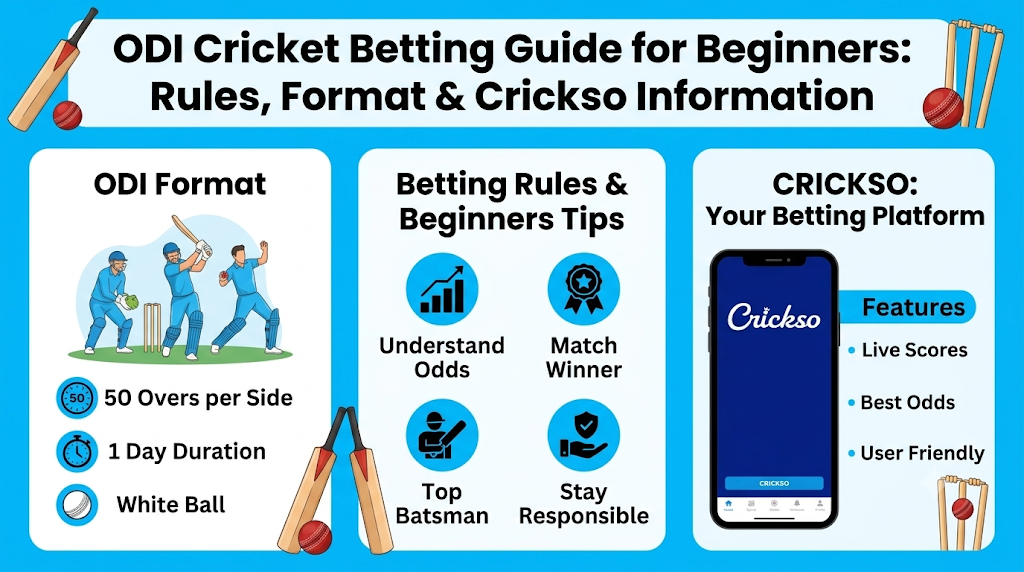
One Day International (ODI) cricket is one of the most popular formats of international cricket. With two teams competing over a maximum of 50 overs each, ODI matches combine batting, bowling, fielding, strategy, and match conditions.
People searching for an ODI cricket betting guide for beginners may want to understand how the format works, which cricket statistics are commonly discussed, and what different betting-related terms mean.
This guide covers ODI cricket rules, match formats, player statistics, common terminology, and general information about Crickso. It also explains important legal considerations for readers in India.
1. What Is ODI Cricket?
ODI stands for One Day International. It is a limited-overs cricket format in which two international teams compete in a match scheduled for one day.
Under standard ODI playing conditions:
- Each team can receive a maximum of 50 overs.
- Each side has one innings.
- The team scoring more runs wins.
- A team may be dismissed before completing its 50 overs.
- Weather interruptions can affect the number of available overs and the match result.
For example, if Team A scores 275 runs and Team B scores 276 runs within its available innings, Team B wins.
If both teams finish with the same score, the match is tied. Specific competition regulations determine how a winner is decided in knockout matches.
2. Understanding the ODI Match Format
An ODI match generally consists of two innings.
First Innings
The team batting first attempts to score as many runs as possible during its available overs.
The batting side builds its innings through singles, doubles, boundaries, sixes, partnerships, and powerplay scoring.
Second Innings
The opposing team bats after the first innings is completed.
Its objective is to reach the target score before running out of its available overs or losing all its wickets.
Example of an ODI Scorecard
| Team | Score | Overs |
|---|---|---|
| Team A | 285/8 | 50 |
| Team B | 286/6 | 48.3 |
In this example, Team B reaches the target with four wickets remaining.
3. Important ODI Cricket Rules Beginners Should Know
A. Maximum 50 Overs
Each team receives a maximum of 50 overs in an uninterrupted standard ODI match.
An over normally contains six legal deliveries. Wides and no-balls do not count as legal deliveries.
B. Powerplay Overs
ODI cricket uses fielding restrictions during designated periods of the innings. These restrictions influence how many fielders can be positioned outside the inner circle and affect the tactical choices of both teams.
C. Wickets
A batting team has a maximum of ten wickets available. Once ten batters are dismissed, the innings ends.
D. Rain-Interrupted Matches
Rain or other interruptions can reduce the number of overs available. The Duckworth-Lewis-Stern (DLS) method may be used in applicable limited-overs matches to revise targets.
E. Tie and No Result
An ODI can end in a tie when both teams finish with equal scores. A match can also produce no result when playing conditions do not allow a valid result to be reached.
4. Cricket Statistics Beginners Should Understand
Cricket statistics help explain team and player performances. They are useful for understanding the game, but they cannot guarantee the outcome of a future match.
| Statistic | Meaning |
|---|---|
| Batting Average | Runs scored divided by dismissals |
| Strike Rate | Runs scored per 100 balls faced |
| Economy Rate | Runs conceded per over bowled |
| Run Rate | Runs scored per over |
| Partnership | Runs scored by two batters together |
| Required Run Rate | Runs per over needed to reach the target |
| Net Run Rate | A tournament statistic comparing scoring and conceding rates |
Batting Average
Batting average provides an indication of a batter’s scoring consistency.
Strike Rate
Strike rate shows how quickly a batter scores runs. It is useful when comparing scoring approaches in limited-overs cricket.
Bowling Economy
Economy rate indicates how many runs a bowler concedes per over.
Required Run Rate
During a chase, the required run rate shows the scoring pace needed to reach the target within the remaining overs.
5. Common ODI Cricket Betting Terminology
People may encounter several betting-related expressions while reading cricket articles or sports discussions.
| Term | General meaning |
|---|---|
| Match Winner | The team recorded as the winner |
| Toss | The pre-match coin toss |
| Odds | A numerical expression of an implied outcome price |
| Over/Under | A comparison against a stated numerical threshold |
| Run Line | A handicap-style comparison based on runs |
| Live Betting | Betting-related activity during an ongoing match |
| Pre-Match | Information or markets presented before a match begins |
These terms describe concepts used in betting-related discussions. Understanding them does not require participating in real-money gaming.
6. Cricket Factors That Influence ODI Match Results
Several sporting factors can influence how an ODI match develops.
Pitch Conditions
The pitch can influence batting, bowling, and scoring patterns. Some surfaces offer more assistance to fast bowlers, while others may help spin bowling.
Weather Conditions
Weather can affect visibility, playing time, and pitch conditions. Rain may also lead to an interruption or reduction in overs.
Team Composition
The balance between specialist batters, fast bowlers, spin bowlers, and all-rounders can influence a team’s approach.
Player Fitness
Injuries, fatigue, and player availability can affect team performance.
Toss and Match Conditions
The toss determines which team chooses to bat or field first. Its importance depends on the conditions and the team’s tactical assessment.
None of these factors makes a match outcome certain.
7. Difference Between ODI, T20 and Test Cricket
Beginners should understand how the three major international formats differ.
| Feature | ODI | T20 | Test |
|---|---|---|---|
| Overs per innings | Maximum 50 | Maximum 20 | No fixed over limit |
| Scheduled duration | One day | Around 3 hours | Up to 5 days |
| Innings per team | One | One | Usually two |
| Playing style | Balanced | Short and aggressive | Long-form strategy |
| Main focus | Run accumulation and wickets | Quick scoring | Endurance and technique |
ODI cricket sits between the shorter T20 format and the longer Test format.
8. Crickso and ODI Cricket Information
Readers searching for ODI cricket information may also come across the Crickso name while exploring online sports-related content.
Crickso is a brand associated with online sports and casino-related platform information. Users researching the brand should distinguish general cricket education from any real-money gaming services or betting-related activity.
For general brand-related information, the following websites are available:
- Crickso Website: https://crickso777.net
- Crickso India: https://crickso247.net
These links are provided as informational references only. Their inclusion does not establish that any service is independently verified, licensed, or legally authorised. Users should check the exact domain, published policies, and applicable laws before relying on online information.
9. Important Legal Considerations for Users in India
Anyone researching cricket betting should understand India’s current online gaming regulations.
The Act’s definition and applicable provisions matter when determining whether a particular activity falls within the prohibition. Ordinary cricket viewing, scorekeeping, and free-to-play social activities should not automatically be treated as online money gaming.
10. Tips for Following ODI Cricket More Effectively
You do not need to be an expert to understand an ODI match. Start with the fundamentals:
- Follow the toss and playing XI announcements.
- Understand the difference between runs, wickets, and overs.
- Learn how batting and bowling averages work.
- Follow partnerships and required run rates.
- Understand how weather interruptions affect match conditions.
- Compare player statistics across different opponents and venues.
- Use official cricket scorecards for accurate match information.
These basics can make watching and understanding ODI cricket much easier.
Frequently Asked Questions (FAQs)
1. What does ODI stand for in cricket?
ODI stands for One Day International. It is a limited-overs format in which each team can receive a maximum of 50 overs.
2. How many overs are played in an ODI match?
In an uninterrupted standard ODI, each team can bat for up to 50 overs. An innings can finish earlier if the team is all out.
3. What is the difference between ODI and T20 cricket?
ODI matches allow up to 50 overs per team, while T20 matches allow up to 20 overs per team. T20 is shorter and generally has a faster scoring pace.
4. What is the DLS method in ODI cricket?
The Duckworth-Lewis-Stern method is used in applicable limited-overs matches to revise targets when interruptions reduce the available playing time.
5. What is a run rate in ODI cricket?
Run rate represents the average number of runs scored per over. It helps describe the scoring pace of a batting team.
6. What is a powerplay in ODI cricket?
A powerplay is a designated period during which restrictions apply to the placement of fielders outside the inner circle.
7. What is Crickso?
Crickso is a brand associated with online sports and casino-related platform information. Readers should independently verify website details and consider applicable legal requirements.
8. Is real-money cricket betting permitted in India?
The Promotion and Regulation of Online Gaming Act, 2025 prohibits online money games and addresses related advertising and financial transactions. The legal classification of a particular service depends on the applicable law.
Final Thoughts
ODI cricket is a fascinating format that combines patience, strategy, teamwork, and exciting sporting moments. Beginners can understand the game more easily by learning the 50-over format, match rules, player statistics, and common cricket terminology.
Crickso is also a name readers may encounter when researching online sports-related information. However, understanding cricket and researching a brand are different from participating in real-money gaming. Always consider applicable laws and prioritise informed, safe engagement with cricket.