Live or Pre-Match: When Is the Best Time to Place a Bet?

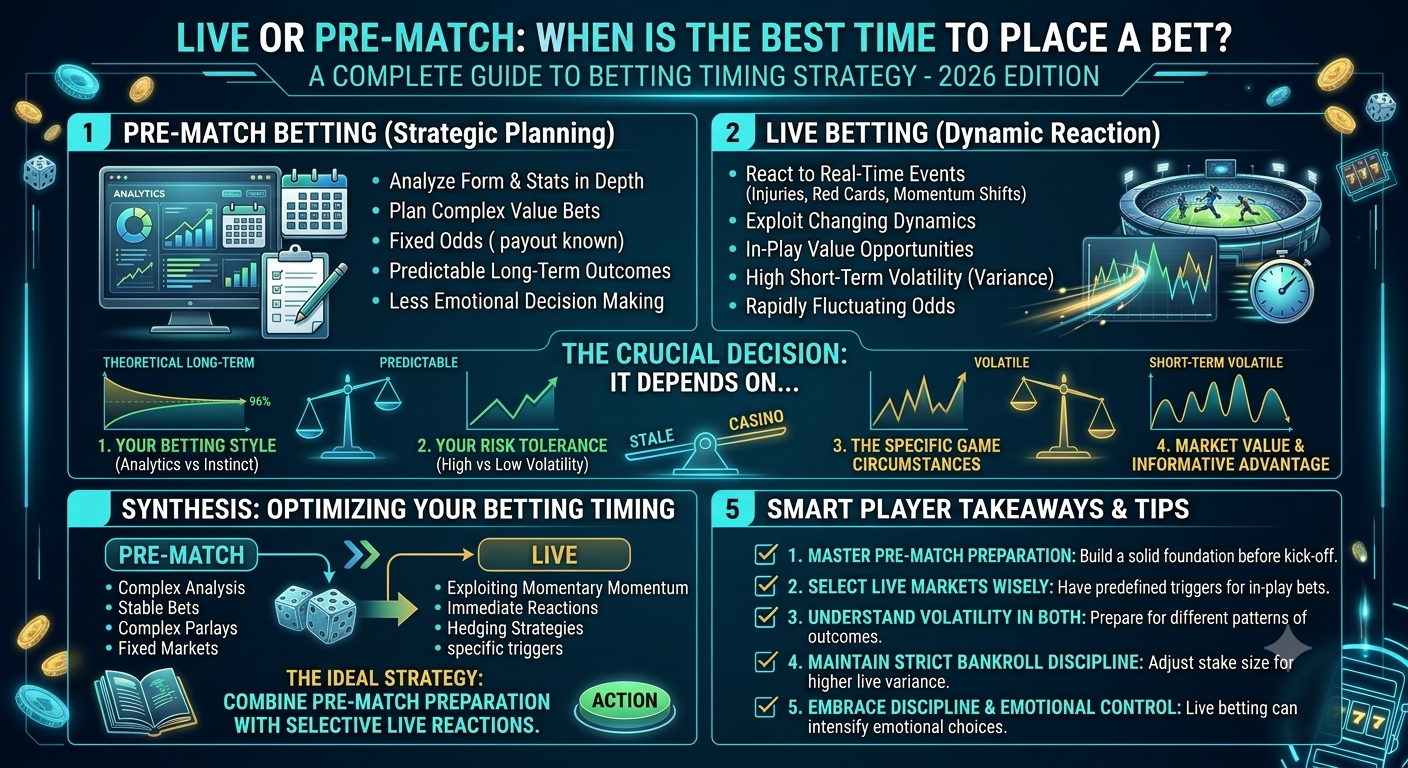
Sports betting markets are generally divided into two broad categories: pre-match betting and live betting. The main difference is when the market is available and what information is used to calculate its odds.
Pre-match markets are available before an event begins, while live markets operate during the event. Both involve uncertainty, changing information and the possibility of financial loss.
Understanding how these two formats work can help readers interpret sports odds, follow market movements and understand the risks associated with betting.
In this guide, we compare live and pre-match betting, explain how odds change, explore the factors that influence each market and answer common questions.
What Is Pre-Match Betting?
Pre-match betting refers to betting markets that are available before a sporting event starts.
The odds are generally calculated using information available before the event, including team performance, player availability, historical statistics and other relevant factors.
For example, before a cricket match begins, a market may display odds for:
- Match winner
- Top run-scorer
- Top wicket-taker
- Total runs
- Tournament winner
These are examples of common market types. Actual market availability varies by sport, competition and operator.
How Pre-Match Odds Are Calculated
Pre-match odds are influenced by several factors:
1. Recent Team Performance
Analysts may examine recent results, scoring patterns, defensive performance and consistency.
2. Player Availability
Injuries, suspensions, squad announcements and changes to the playing XI can influence market expectations.
3. Historical Performance
Previous meetings between teams may provide context, although historical results do not guarantee similar future outcomes.
4. Match Conditions
In cricket, factors such as pitch characteristics, weather forecasts, ground dimensions and the toss can influence expectations.
5. Market Demand
Odds may also change as market participants respond to new information and changing demand.
Pre-match odds therefore represent an assessment based on information available at that moment. They are not a guarantee of the eventual result.
What Is Live Betting?
Live betting, also called in-play betting, refers to markets that operate while a sporting event is taking place.
Unlike pre-match markets, live markets can change as the match develops. New information becomes available after every important event, and odds may be updated accordingly.
For example, during a cricket match, market prices may respond to:
- Wickets falling
- Runs being scored
- Changes in the required run rate
- A batter reaching a milestone
- An injury or player retirement
- Weather interruptions
- Changes in match conditions
Live markets are dynamic, which means the information available before the match may become outdated quickly.
How Live Betting Odds Change
Consider a hypothetical cricket match.
Before the match begins, Team A may be considered the stronger side. However, if Team A loses several early wickets, the market may reassess its chances.
Similarly, if Team B needs only a small number of runs with several wickets remaining, its market price may change.
The important point is that live odds respond to changing match conditions. They do not make the final result certain.
Live Betting vs Pre-Match Betting: Main Differences
The two formats differ in timing, available information and the speed at which markets change.
| Feature | Pre-Match Betting | Live Betting |
|---|---|---|
| Availability | Before the event starts | During the event |
| Information | Pre-event analysis | Live match developments |
| Odds movement | May change before the start | Can change frequently |
| Market speed | Generally less immediate | Often very fast |
| Match information | Based on available pre-match data | Includes ongoing events |
| Main uncertainty | Events that have not started | Remaining events and match developments |
Neither format removes uncertainty. Live markets simply incorporate more information about an event that is already underway.
Advantages and Limitations of Pre-Match Markets
Pre-match markets allow people to study an event before it begins. They also provide more time to understand the available information.
Potential Advantages
More Time for Research
There is generally more time to examine team news, player statistics and match conditions before the event starts.
More Stable Information Environment
The match has not yet begun, so there are no live scoring changes or immediate in-play developments.
Easier Market Comparison
Pre-match odds can be compared over a longer period, although prices may still change when new information becomes available.
Limitations
Unexpected Team Changes
Late injuries, withdrawals or lineup changes can affect the assumptions behind pre-match analysis.
Conditions May Differ From Expectations
Weather, pitch behaviour and other conditions may not develop as expected.
No Live Match Information
Pre-match markets cannot account for events that happen after the match begins.
Advantages and Limitations of Live Markets
Live markets provide information based on an event that is already in progress. However, their fast-moving nature creates additional challenges.
Potential Advantages
Access to Ongoing Match Information
Market prices can reflect current scores, wickets, player performance and other developments.
Changing Match Context
The relative position of teams can change significantly during an event. Live markets reflect those developments.
More Detailed Market Types
Depending on the sport and event, live markets may include specific periods, overs, sets or individual performance outcomes.
Limitations
Rapid Odds Changes
Prices can change quickly, sometimes before a person has enough time to understand the latest development.
Delayed Information
A live stream, scorecard or data feed may not always update at exactly the same time as a market.
Market Suspension
Markets may temporarily become unavailable during important moments, such as a wicket, penalty, goal or other significant event.
Greater Pressure
Fast-moving markets can encourage rushed decisions. This can make it harder to assess information calmly.
What Factors Influence Live and Pre-Match Odds?
Although both formats use similar underlying information, the timing and importance of individual factors can differ.
1. Team and Player Form
Recent performance can influence expectations before an event. During the match, actual player performance provides additional information.
2. Injuries and Player Availability
A key player being unavailable can affect pre-match expectations. An injury during the event may cause a fresh market adjustment.
3. Weather Conditions
Weather forecasts can influence pre-match analysis. During a match, rain, wind or changing conditions may have an immediate impact.
4. Pitch and Playing Surface
In cricket, the pitch can influence batting and bowling conditions. Observations during the match may differ from expectations formed before the toss.
5. Match Situation
The score, wickets remaining, overs remaining and required run rate can all influence live cricket markets.
6. Market Activity
Odds may move as market participants respond to information. A price movement should not automatically be interpreted as proof that a particular outcome is likely.
Cricket Example: How Pre-Match and Live Markets Differ
Cricket provides a useful example because match conditions and team positions can change considerably during an innings.
Consider a hypothetical T20 match between Team A and Team B.
Before the Match
Before the first ball, market expectations may be based on:
- Recent team results
- Squad strength
- Playing conditions
- Venue statistics
- Player availability
- Historical performance
At this stage, neither team has started scoring or taking wickets in the current match.
During the First Innings
Once the match begins, new information becomes available.
For example:
- Team A scores quickly during the powerplay.
- Team A loses two wickets in consecutive overs.
- A key batter reaches a half-century.
- The scoring rate changes during the middle overs.
Each development can affect expectations about the final total and match outcome.
During the Second Innings
The chasing team’s position can be evaluated using:
- Current score
- Required run rate
- Overs remaining
- Wickets remaining
- Batters at the crease
- Bowling options available
This illustrates why live market prices can change frequently. The match situation is continuously developing, and no single statistic can determine the final result.
Why Do Live Odds Change So Quickly?
Live odds can change rapidly because sporting events generate new information continuously.
In cricket, a single over may include several runs, a wicket, an injury or a major change in the required run rate.
In football, a goal, red card or penalty can significantly change the match situation.
In tennis, a break of serve or an injury can influence expectations about the result.
Market systems may update prices automatically using data feeds and mathematical models. Markets can also be suspended while an important event is being confirmed.
This means live odds should be understood as changing market prices, not as reliable predictions.
Common Mistakes When Comparing Live and Pre-Match Markets
Understanding the differences between these formats is important, but several common misconceptions can lead to poor decisions.
Mistake 1: Assuming Live Odds Are More Accurate
Live markets have additional information, but more information does not guarantee a correct prediction. Data delays and unexpected events can still affect market assessments.
Mistake 2: Treating Pre-Match Odds as Final
Pre-match odds can change before an event begins. Team news, weather and other developments may alter market expectations.
Mistake 3: Chasing Losses During Live Events
Trying to recover previous losses by making more decisions can increase financial risk. A previous loss does not create an obligation or mathematical reason to continue.
Mistake 4: Ignoring Market Suspension
A market may be suspended during an important event. This is a normal feature of many live market systems and should not be interpreted as evidence of a guaranteed outcome.
Mistake 5: Relying Only on Recent Results
Recent results provide context, but they do not fully describe a team’s current condition or determine what will happen next.
Mistake 6: Believing Faster Decisions Are Better
Live markets can move quickly, but reacting immediately is not necessarily beneficial. Fast decisions can increase the chance of overlooking important information.
Live or Pre-Match: Which Is Better?
There is no universal answer to this question. The two formats serve different purposes and involve different types of uncertainty.
Pre-match markets are based on information collected before an event. Live markets incorporate developments that occur during the event.
From an educational perspective, the main distinction is the timing of information:
- Pre-match markets show how expectations are formed before play begins.
- Live markets show how expectations can change as new information becomes available.
Neither format guarantees a favourable result or removes the possibility of financial loss.
For readers studying sports markets, understanding how prices change is more useful than assuming that one format is always better.
Crickso and Sports Market Information
Readers researching sports-related platforms and online gaming information may also come across the Crickso name.
You can explore the following websites for information associated with the brand:
- Crickso Website: https://cricksoindia.com
- Crickso India: https://cricksolive.com
These links are provided as references for readers interested in exploring the websites. Their inclusion does not verify the availability of particular betting markets, live odds, services, licences or regulatory approvals.
Before relying on any website, independently review its ownership information, terms, regulatory status and applicable laws. Do not assume that a platform is legally permitted to offer online money gaming in India simply because its website is accessible.
Online Money Gaming Laws in India
Readers in India should understand the legal framework before accessing online gaming or betting-related services.
The Promotion and Regulation of Online Gaming Act, 2025 prohibits online money games and addresses related services, advertising and financial transactions. The Act applies to online money gaming services offered within India or operated from outside India.
The Promotion and Regulation of Online Gaming Rules, 2026 came into force on 1 May 2026 and provide an implementation framework.
Accordingly, readers should not assume that real-money sports betting is lawful in India because a platform operates internationally or describes a game as skill-based. Check the current official legal position and obtain qualified legal advice where necessary.
Frequently Asked Questions
1. What is the difference between live and pre-match betting?
Pre-match betting markets are available before an event starts. Live betting markets operate while the event is taking place and can change as new information becomes available.
2. What does pre-match mean in sports betting?
Pre-match refers to the period before a sporting event begins. Market expectations during this period are generally based on team news, player availability, statistics and other pre-event information.
3. What is live betting?
Live betting, also known as in-play betting, refers to markets that operate during a sporting event. Prices may change in response to scores, wickets, goals, injuries and other developments.
4. Why do live odds change during a cricket match?
Live odds can change because the score, wickets, overs remaining, required run rate and player performance affect the market’s assessment of the match.
5. Can pre-match odds change before a match starts?
Yes. Team announcements, injuries, weather updates and market activity can influence prices before the event begins.
6. Are live betting odds always more accurate?
No. Live markets include additional information, but they can still be affected by delayed data, uncertainty and unexpected events.
7. Why are live markets sometimes suspended?
Markets may be suspended while an important event is happening or being confirmed. This can occur after a wicket, goal, penalty or other significant development.
8. Is live betting legal in India?
India’s Promotion and Regulation of Online Gaming Act, 2025 prohibits online money games and related activities. The Rules, 2026 came into force on 1 May 2026. Readers should consult official sources for the current legal position.
9. Does pre-match analysis guarantee a correct prediction?
No. Statistics and team information can help explain market expectations, but they cannot guarantee the outcome of a sporting event.
10. What should readers understand before comparing sports markets?
Readers should understand how odds work, what information influences prices, why markets change and what legal restrictions apply in their location.
Final Thoughts
Live and pre-match markets differ mainly in the timing and availability of information.
Pre-match markets reflect expectations formed before an event begins, while live markets respond to developments during the event. Both can change, and neither can remove the uncertainty associated with sports results.
Understanding these differences helps readers interpret sports market terminology more clearly. It is also important to recognise the financial and legal risks associated with online money gaming.
Disclaimer: This article is for educational and informational purposes only. It does not encourage participation in real-money betting or promise any financial returns. Online money gaming is subject to legal restrictions in India. Always consult official legal sources before engaging with online gaming services.